
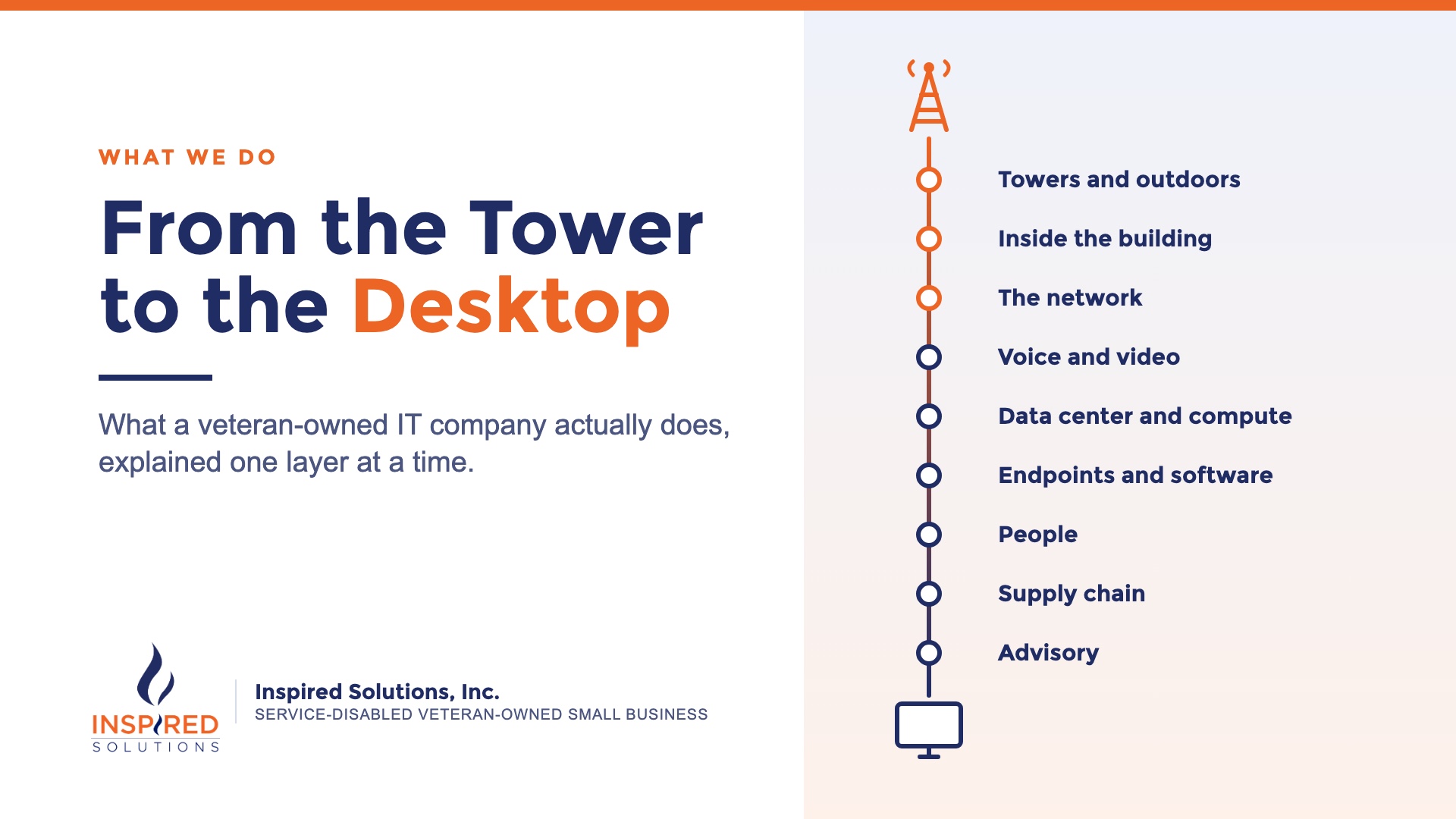
Federal buyers get one accountable partner from the outdoor tower to the desktop in the cubicle. Inspired Solutions, Inc. is a veteran-owned IT company in Manassas, Virginia. We hold Service-Disabled Veteran-Owned Small Business (SDVOSB), 8(a), Woman-Owned Small Business (WOSB), and Economically Disadvantaged Woman-Owned Small Business (EDWOSB) status.
Program offices rarely buy one thing. A base needs a radio signal that reaches the basement. It needs a network that knows who is on it, a conference room that works the first time, and a desktop that loads. When one company understands all of those layers, the hand-offs between vendors stop being your problem.
Our chief operating officer served 25 years in the Army. We run projects the way he learned to run them: one owner, clear phases, and acceptance before the next step.
How to read this post
We walk through nine layers, from the outside of a facility to the person at the desk. Each layer has three parts:
What it is: the layer in plain English.
What we did: real projects. We name the type of customer, never the customer.
Who does the work: the roles we put on the job.
We keep this list to executed and active work. Where a project is still under way, we say so.
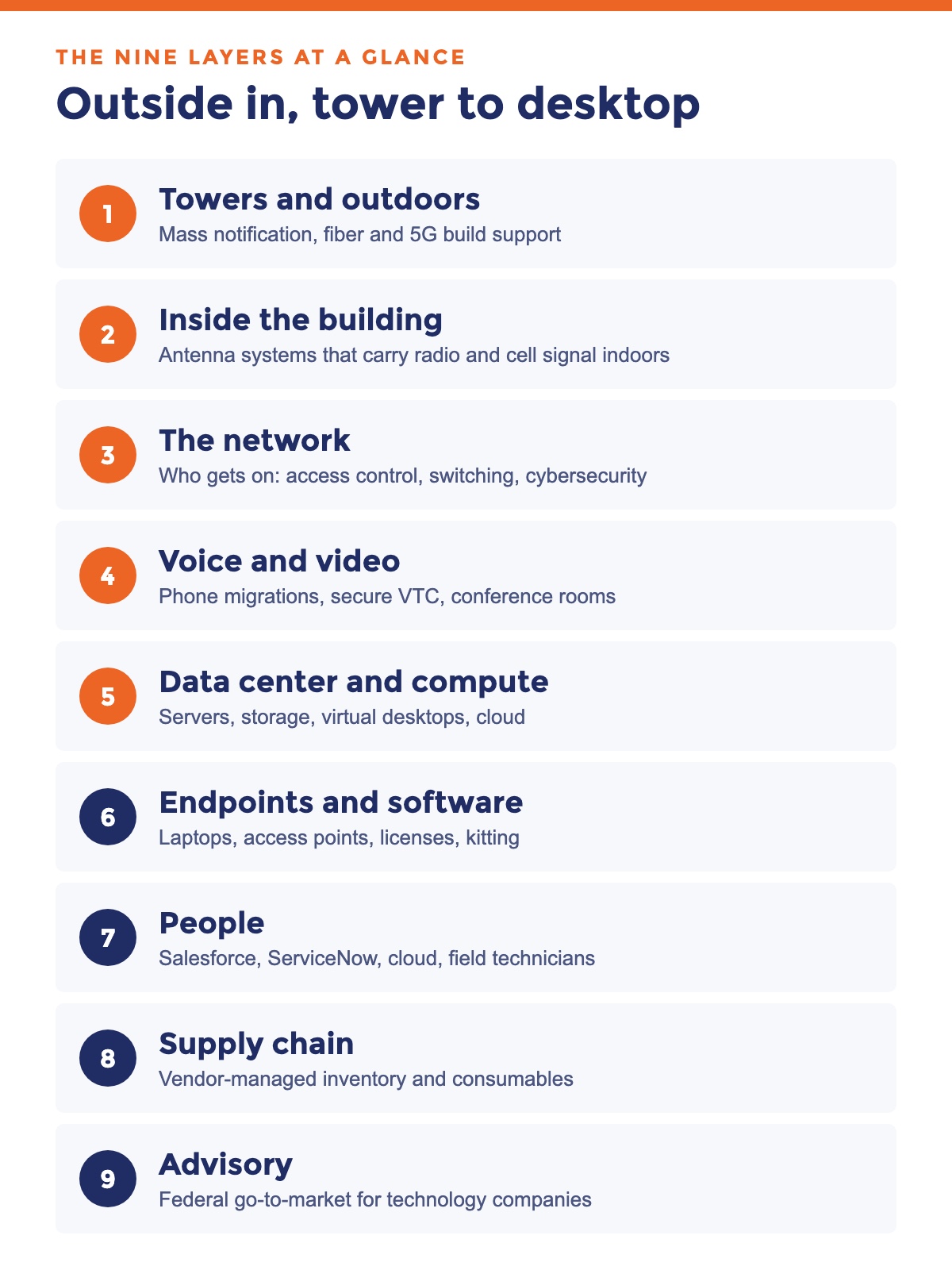
Layer 1: Towers and the outdoors
What it is: the systems on poles and towers that reach people outside, and the material that outdoor builds run on.
What we did:
At an Air Force base, we expanded a Giant Voice mass notification system. The work added two new tower poles with speaker arrays, siren controllers, and radios. Each site runs on solar power with battery backup and carries lightning protection. The towers tie back into the base alerting system.
We supported a carrier's fiber and 5G build across eight states. We ran the warehouses, the procurement, and the staffing so crews had material when they needed it.
On a utility transmission line, we procured and delivered the structural concrete for pole foundations, pour by pour, around the weather.
Who does the work: installation technicians, project managers, and warehouse and procurement staff.
Layer 2: Inside the building
What it is: radios and cell phones fail inside thick walls. A distributed antenna system (DAS) carries the signal through the building.
What we did:
At an Air Force base, we designed and installed a DAS for radio coverage in one building. Our installer and the base communications staff walked the building with portable radios and confirmed coverage at the antenna locations.
We hold a new five-year task ordering agreement with a Department of Energy national laboratory. Its scope covers DAS maintenance, monitoring, and 5G network design. The first two task orders, DAS monitoring and a DAS hardware refresh, were signed in October 2026. That work is just starting.
At a federal intelligence agency headquarters, we supported construction-phase IT for 40 months: equipment procurement, logistics, structured cable plant, power distribution, and DAS radio network engineering.
Who does the work: DAS installers, radio network engineers, and cabling crews. See our voice and wireless work.
Layer 3: The network
What it is: the network decides who gets on and who does not. This is where cybersecurity starts.
What we did:
At an Air Force base, we rebuilt network access control on a classified network in two weeks on site. Cleared engineers did the work, joined it to the directory, and trained the base IT staff in two sessions.
On the unclassified side of the same base, we installed and configured the network access control platform on seven servers.
For a state department of transportation, we supplied rugged industrial switches for a LAN upgrade. One order covered 112 switches. The next order added 50.
At a VA medical center, we supplied and supported the data center switching upgrade, scheduled around clinical operations.
Who does the work: cleared network access control engineers and network engineers. See our network and security services.
Layer 4: Voice and video
What it is: the phones, the conference rooms, and the video links between them. Legacy phone trunks are a risk, and they are going away.
What we did:
At an Air Force base and a second military installation in the same state, we moved voice from time division multiplexing (TDM) to Session Initiation Protocol (SIP) in two phases. The second phase did not start until the government accepted the first.
For an Army signal battalion in Japan, we procured and shipped the IT room infrastructure behind a voice over IP (VoIP) upgrade. Power systems, server enclosures, and conduit reached three Pacific installations.
For a classified facility, we sourced secure video teleconference (VTC) equipment: 11 line items, 122 units. We answered the request within one day.
At an Army arsenal, we upgraded six spaces with video conferencing and digital signage.
Who does the work: voice engineers, VTC and audiovisual technicians, and procurement specialists. More on audiovisual and collaboration.
Layer 5: Data center and compute
What it is: the servers, storage, and virtual desktops behind every application.
What we did:
Virtual desktops (VDI) on a classified network were failing at an Air Force base. Users lost logins, sessions hung, and master images would not publish. Our cleared engineer delivered the full assessment in three days against a 30-day window and documented six findings. We closed four under our own control. The other two waited on government-furnished actions, and we tracked them to completion. The government accepted the work.
At 13 VA facilities, we are installing 21 servers.
On a VA high-performance computing program scoped for 176 sites, we deliver site assessments and server installations. That work is under way.
At an Air Force base, we are refreshing storage across two buildings with 800 TiB (tebibytes) of usable capacity.
For a Class I railroad, we upgraded and migrated seven pairs of load balancers and ran a discovery for the next software platform.
For a pharmaceutical company, we moved an application delivery service to the public cloud.
Who does the work: cleared systems engineers, server and storage installers, and cloud and application delivery engineers.
Layer 6: Endpoints and software
What it is: the laptops, access points, and software licenses people touch every day.
What we did:
For a pharmaceutical company, we sourced 3,000 laptops and staged inventory near the customer so units shipped as needed. We also ran a software license management engagement for its research labs.
For a federal agency, we delivered 45 licenses of a DevSecOps platform with US-citizen support, under an 8(a) sole source award.
We kitted 1,000 wireless access points in a single program. In another, we built 475 multi-component network kits and shipped each to its own address.
Who does the work: procurement specialists, software license analysts, and kitting technicians. See our logistics and kitting services.
Layer 7: The people
What it is: some projects need a person, not a product. We place skilled people inside our customers' programs.
What we did:
On an Army enterprise program, we fill two seats: a Salesforce Developer and a Salesforce Operations Officer, who works as a business analyst.
For a state government, through a large technology integrator, we placed four senior contractors: a ServiceNow senior engineer, two ServiceNow developers (one also a senior architect), and a cloud architect.
We also build the bench. Our technician apprenticeship program has graduated more than 1,200 technicians.
Who does the work: the people above. Read about our workforce programs.
Layer 8: The supply chain
What it is: the right parts, on the right shelf, before the crew needs them.
What we did:
A large technology integrator relies on our vendor-managed inventory program to keep consumables moving to its production floor.
From March through December 2025, our team processed 1,278 bills of materials and placed 317 purchase orders with five vendors.
Over that period the program managed more than 1.6 million units of material.
Our team cut pick-ticket processing from about a day and a half to about an hour per cart.
Who does the work: warehouse and inventory staff, buyers, and a program manager. Military discipline shows up on the shop floor as regular cycle counts and monthly vendor scorecards. This is vendor-managed inventory at work, and our procurement team runs the same playbook.
Layer 9: The advisory
What it is: the business layer. Technology companies hire us to advise them on selling to the federal government, because we know how federal buyers evaluate and award.
What we did:
We delivered a 16-month federal go-to-market engagement for a major cloud provider's defense team.
We advise a data security software company on its federal market entry.
Who does the work: federal business development advisors.
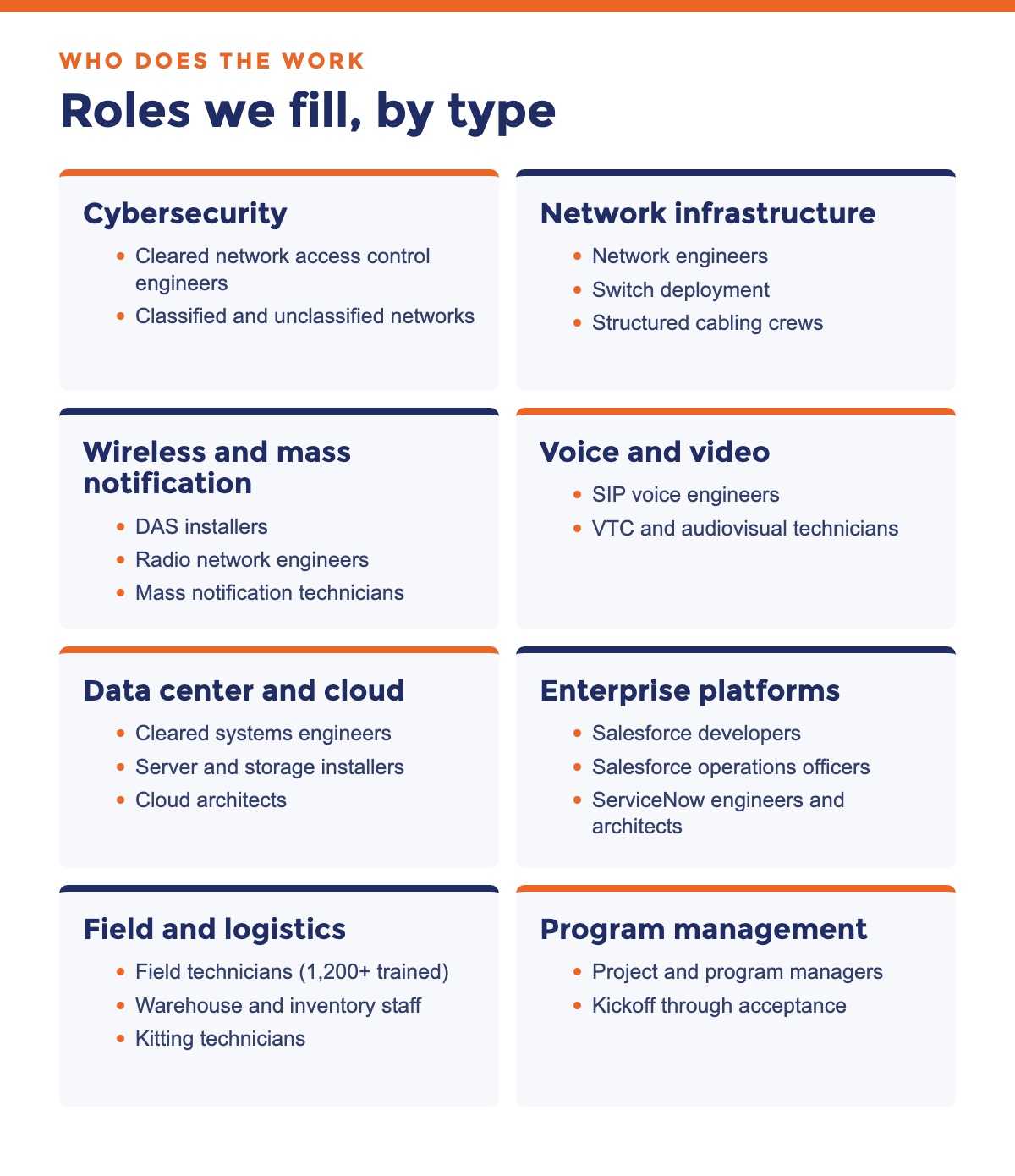
Roles we fill, by type
If you need a person or a team, here is the short version, grouped by type of work:
Cybersecurity: cleared network access control engineers who control who gets on classified and unclassified networks.
Network infrastructure: network engineers, switch deployment, and structured cabling crews.
Wireless and mass notification: DAS installers, radio network engineers, and mass notification technicians.
Voice and video: SIP voice engineers and VTC and audiovisual technicians.
Data center and cloud: cleared systems engineers, server and storage installers, and cloud architects.
Enterprise platforms: Salesforce developers, Salesforce operations officers, and ServiceNow engineers, developers, and architects.
Field and logistics: field technicians, warehouse and inventory staff, and kitting technicians.
Program management: project and program managers who own the schedule from kickoff to acceptance.
How to buy from a veteran-owned IT company
Every layer above is a buying path. Pick the one that fits your requirement.
SDVOSB and 8(a) set-asides, and 8(a) sole source. Use these when your requirement fits the program. Our how to buy guide walks through each.
General Services Administration (GSA) Multiple Award Schedule (MAS), contract 47QTCA22D00DQ. See the GSA MAS page.
NASA Solutions for Enterprise-Wide Procurement (SEWP) VI. We hold Category A (80TECH26D1138) and Category C (80TECH26D0142). See the SEWP VI page.
Primes and program offices, tell us which layer you need. We will tell you where we have done it, who did the work, and how fast we can start. We also team with primes that need a certified small business partner on a pursuit.
Review all of our services, or request a quote.